Search results for tag #privacy
![[?]](https://public.mitra.social/media/ea33ac46ee9134f46604a8de057321fb61f6e103858bbe85145558c7986bbe9a.jpe)
Chatrie v. United States
Police officers conducted a Fourth Amendment search when they acquired Okello Chatrie’s location data from Google because an individual has a reasonable expectation of privacy in his cellphone location information.
But is that really the case? Sure, your phone's location data, and (in this country at least) a reasonable expectation of privacy, and that would presumably include cellular data the carriers have.
But does it really include location data that Mr Chatrie sold (bartered, traded in kind for access to network services instead of being charged directly for them) to Google, #Amazon, Faceplant, and other companies who buy ( with the right to resell in exchange for the privilege of utilizing their network services) this data - specifically to sell this privacy mined data to other third party aggregators and.... wait for it.... presumably those who either are, or would sell it to law enforcement agencies on the open market?
Lemme break that down into the crux of the biscuit. Faceplant, InstaSpam, TakToe, Google, Amazon, and others, buy your privacy in a transaction that includes your access to their services - that's the fee for using Faceplant (You know it's not free).
Most of those companies are built wholly, or in part, on this form of legally privacy mining you (in exchange for you using their services). That's how you pay for access to their services. They, in turn, sell that data for operating costs of their business product and hopefully make a profit by doing so.
That sure sounds like consensual sex to me!
So, what's the difference between selling your privacy mined data to other aggregators, for advertising, whatev, and law enforcement?
Don't get me wrong, I think that both notions are atrocious injustices:
- selling your privacy to have access to their network
- Selling that privacy mined data to law enforcement
Let's not church it up here folks - You went to the crossroads, just like Robert Johnson and sold your eternal soul so you could post stupid pictures of yourself on InstaSpam. You literally paid #Meta for network access and the use of their products (InstaSpam and FacePlant and Wassup). You litterally paid google for access to and the use of Google Docs and Gmail and YouTube, gDrive, Etc., (Wait for it...) by giving them permission over the ownership of a certain amount of your personal data (location, posts, private emails, documents saved on Google infra, etc.).
And you wanna know what's wrong with them providing law enforcement with this info.... without a warrant? Umm... Because you sold it to them so they could sell it to others on the open market!!!.
Now, I think there could be distinctions between just handing over data without an actual warrant, and selling that data to law enforcement. The former sounds like infringement of rights while the latter sounds perfectly reasonable to me - both resulting in the exact same disclosure of (potentially) your most private secrets.
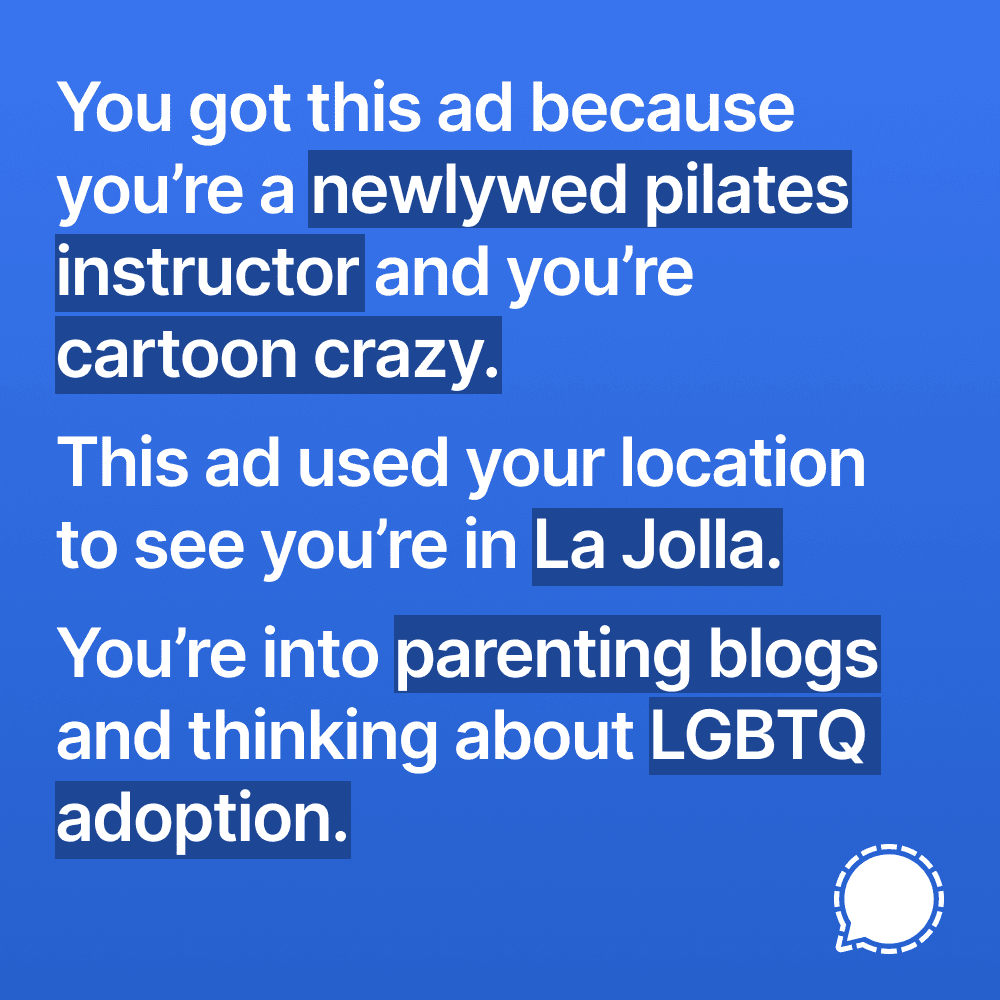
"You got this ad because you're a teacher, but more importantly you're a Leo (and single). This ad used your location to see you're in Moscow. You like to support sketch comedy, and this ad thinks you do drag,"
Ew that must've stung!
Once upon a time you could just track virtually anyone's location on Faceplant in real time, but when some people started complaining and there were concerns about potential stalkers, they began shoring this up - first, with Opt-out, but eventually, just removing that capability from the platform for all intents and purposes.... sort of.
There are plenty of companies who publish their AUPs and ToS's explaining that under no circumstances will they divulge shit about you without a legally compelling warrant - further, many of these sites/companies often also publish a Warrant Canary. None of these businesses are of the stature that rises to the level of a #Big_Tech stature.
Here's a bit more on the topic of Warrant Canaries. And another #Warrant_Canary example is HERE.
Now, let's not get all upset about an innocent person being persecuted - Okello Chatrie is a fricken' bank robber who walked into and robbed a credit union in Virginia on the 20th of May in 2019.
If you read through that opinion, you may get the impression that the damming information was cellular data - but I don't believe that's the case; rather, I believe it was GPS data that Alphabet (aka Google) collects with your permission, as a condition agreed to so that you can use Google stuffs. You may say 'same difference', but if it was Geolocation based on GPS data that Google collected from his phone (rather than cellular data provided by the cellular carrier that was his provider), that's an important distinction (Besides, Neither T-Mobile nor Verizon are mentioned).
Anyway, he's a despicable scumbag to be sure, but did he give permission for Google to sell that information to other parties as a result of Google's consent for him to gain access to Googles services? After all, Google paid for the right to do so (when he sold his soul).
Where the distinction becomes relevant, as I see it, oh.... wait... disclaimer (IANAL). There, let's move along, in lay terms, coz I'm a lay person. Anyway, as I see it, Google didn't actually [legally] sell this information to a third party, namely the FBI and other law enforcement agencies - They provided under the terms of a warrant that was issued demanding that it be provided.
That might be nit-picking to some, but I think that's a HUGE distinction. Further, had the cops come to Google and asked if they would sell his geolocation data to them, I believe that it may have been a perfectly acceptable and legal transaction - after all, he did sell his privacy rights at the cross-roads.
But this was a judicial warrant, and the information was subpoena'd (I'm reaching here with the nomenclature, but you get the gist of what I'm saying here.
For a warrant demanding the information, he had a reasonable expectation of privacy. For the sale of the disclosure of information privacy farmed in his Google account for these very purposes, the sale would have, or rather might have, been perfectly legal.
I dunno. I'm interested in your take on this.
So, did the #InstaSpam users have an expectation of privacy to keep #Signal from publishing their private information? Nope! Because that data was legitimately purchased from #Faceplant (Meta, Whatev).
On the other hand, was the same data that law enforcement could have presumably legally purchased from #Google, but chose instead to acquire by court order, substantively any different due to the method they incorporated to secure that data?
Was this a subtle difference? Because I could buy that data from Google if I wanted to, right? Was it just because it was #law_enforcement?
In closing, again, I reiterate that #IANAL but it seems to me that there sure are a lot of crux in that biscuit.
#tallship #privacy_mining #privacy #industrial_surveillance #Supreme_Court
⛵
Alt...
One of thousands of potential ads that were served to InstaSpam users in a legal and permissable ad campaign purchased by Signal from Faceplant.
![[?]](https://social.terminaltilt.com/system/accounts/avatars/116/739/937/878/244/415/original/534d8bc85c9bdceb.png)
I was thinking about how much I like having Adnauseam just doing its thing, clicking every ad it comes across to poison the well. Can you imagine scaling it up to hundreds of headless browsers that just click ads to ruin the ad economy? They would try to send you to jail.
"Your Honor, the defendant clicked ads he didn't want to see."
"The ad network tracked him across 300 websites without his knowledge."
"Court adjourned. Everyone go home."
![[?]](https://lemmy.today/pictrs/image/e505f425-7c74-4e24-8fee-f560b3a205c6.jpeg)
Some good news for a change: City of South Portland, Maine has removed all flock cameras after public push-back.
![[?]](https://f2.tchncs.de/accounts/avatars/109/250/308/897/663/702/original/93d28ed1a7a754a2.jpeg)
US-Urteil erschüttert das Fundament des transatlantischen Datentransfers | heise online https://www.heise.de/news/Kartenhaus-Wie-ein-US-Urteil-den-transatlantischen-Datenfluss-sprengen-koennte-11349599.html #Datenschutz #privacy #DSGVO #GDPR
![[?]](https://nbg1.your-objectstorage.com/tno-mastodon/accounts/avatars/111/434/264/745/920/273/original/52ff85db085a2a1d.jpg)
![[?]](https://fe.upload.disroot.org/media/f7c029f9dff5af946bc869b1abf96a8e120ab768990036d1a0222548cf526495.png)
Have a listen at https://podcast.switchedtolinux.com, via RSS feed or using your preferred method!
!!! ALL HAIL THE VAN PANTHER !!!
DESCRIPTION: "Today we talk about Sony removing more content from people's libraries after they bought movies."
!!! NOTE !!! This post is best viewed on a PC. Switched To Linux is, “written by a broad spectrum computer consultant to help people learn more about the Linux platform.” This account is a supporter of Switched To Linux and provides convenience posts of thumbnails art, videos and streams.
#SwitchedToLinux #Linux #Windows #Mac #Technology #Tech #AltTech #Privacy #Private #Security #Secure #FOSS #FreeAndOpenSource #FreeAndOpenSourceSoftware #FreeOpenSourceSoftware #Podcast #Patreon #Twitch #AltTech #FactCheckTrue #Fediverse #SocialMedia #Podcast #stoptheslop #movies #sony #streaming
!!! Tell us what you think by filling out a "SATISFACTION SURVEY or ABUSE/SPAM REPORT" form from Teh AnKorage !!!
https://cryptpad.disroot.org/form/#/2/form/view/elsOVQUrXAmGuer4kd75JhA3mNELuCj8cTjEUynrZZo/


![[?]](https://cdn.masto.host/mastobotpingmoi/accounts/avatars/109/784/559/083/663/340/original/a252954b2ea73583.jpg)
Apple's Hide My Email génère des alias pour masquer votre vraie adresse — mais si les emails transitent quand même par des serveurs identifiables ou que les métadonnées restent exposées, l'anonymisation est partielle. La protection vie privée, c'est une surface d'attaque entière, pas un champ de formulaire. #privacy #infosec #Apple
https://www.engadget.com/2206382/apple-s-hide-my-email-may-not-be-hiding-anything/
A new gay dating app appears designed to harvest sensitive data under cover of community-building. Dating apps already carry high-value personal data — location, identity, social graph. When the origin or intent of an app is opaque, the threat model shifts fast. Worth reading before installing. #OSINT #privacy #infosec
https://www.wired.com/story/goose-a-new-gay-dating-app-appears-to-be-a-psyop/
I am trying out Technitium DNS as my home resolver. Coming from Pi-hole and AdGuard, so far it feels like a legit upgrade. More features, less hand holding.
#Technitium #DNS #Selfhosting #Privacy

Alt...
Technitium DNS dashboard showing stats for the last hour, totals, errors, cached, and blocked counts with a line graph.
![[?]](https://files.mastodon.social/accounts/avatars/115/565/301/135/627/370/original/5a69afadc00de9cb.png)
Every week brings another breach, and a pattern underneath them: the more identity a system collects, the more there is to steal. Passports, fingerprints, phone numbers, all sitting in databases waiting to leak.
The fix isn’t better security on all that data. It’s not collecting it in the first place.
Zerion asks for nothing. No phone number, no email, no ID. Nothing to breach because nothing is stored.
zerion.chat
![[?]](https://a.mindlycdn.com/accounts/avatars/109/314/751/759/220/747/original/0f68fdbbfd257b21.jpg)
I'm kind of surprised that the US "intelligence" establishment hasn't taken out a hit on Max Schrems by now.
#privacy #GDPR #SafeHarbour #MaxSchrems #SafeHarbourAgreement #spying
Etappensieg mit Beigeschmack: EU-Parlament trotzt vorerst der #Chatkontrolle | heise online https://www.heise.de/news/Etappensieg-mit-Beigeschmack-EU-Parlament-trotzt-vorerst-der-Chatkontrolle-11349737.html #ChatControl #Datenschutz #privacy #surveillance #Überwachung #Verschlüsselung #encryption
All hail the Van Panther
Click on, "Show More" or "Read More" to get the links.
DESCRIPTION of the content found at the links, below - "Today we talk about Sony removing more content from people's libraries after they bought movies."
==========
NOTE - This post is best viewed on a PC. Switched To Linux is, “written by a broad spectrum computer consultant to help people learn more about the Linux platform.” This account is a supporter of Switched To Linux and provides convenience posts of thumbnails art, videos and streams.
#SwitchedToLinux #Linux #Windows #Mac #Technology #Tech #AltTech #Privacy #Private #Security #Secure #FOSS #FreeAndOpenSource #FreeAndOpenSourceSoftware #FreeOpenSourceSoftware #YouTube #Odysee #Rumble #BitChute #Locals #Patreon #Twitch #AltTech #FactCheckTrue #Fediverse #SocialMedia #stoptheslop #movies #sony #streaming
==========
After viewing the content located at the below links, Tell us what you think by filling out a "SATISFACTION SURVEY or ABUSE/SPAM REPORT" form from Teh AnKorage
https://cryptpad.disroot.org/form/#/2/form/view/elsOVQUrXAmGuer4kd75JhA3mNELuCj8cTjEUynrZZo/
\*Videos and podcasts may take a considerable amount of time to post. If it is not present, it will be, soon(tm).
MATRIX! Join our Matrix community where you can chat about Linux and general tech topics. Also, direct video links are provided for our Matrix community members! Don't miss out!
https://matrix.to/#/#switchedtolinux:matrix.org
#YouTube - https://www.youtube.com/@SwitchedtoLinux/videos
#Odysee - https://odysee.com/@switchedtolinux:0?view=content
#Rumble - https://rumble.com/c/SwitchedToLinux/videos
#Bitchute - https://www.bitchute.com/channel/uf9hzD216LX0
==========
Keep an eye out for a possible podcast!
PODCAST: https://podcast.switchedtolinux.com