Search results for tag #openbsd
![[?]](https://media.bsd.network/accounts/avatars/110/037/496/070/316/553/original/ded09a624a7ff99d.jpg)
Wishing all our *BSD 😈⛳🐡 friends an amazing time at @bsdcan in Ottawa!
#RUNBSD #FreeBSD #NetBSD #OpenBSD #BSD #BSDCan

Alt...
Still image from the movie Monsters Inc.
Mike Wazowski seen from the back looking into a wide hallway with a group of monsters walking towards him.
It has the text:
Me watching my friends having fun without me.
![[?]](https://d35e9bfo1msux2.cloudfront.net/accounts/avatars/109/535/770/898/980/239/original/fe47a9c6a062442b.png)
A little background info:
The #OpenBSD blame for #nc. See line 705, tagged revision 1.21 and dated 2001-06-25.
https://cvsweb.openbsd.org/annotate/src/usr.bin/nc/netcat.c
Version 1.10. Note that the entire holler() fuction, called on line 1585, is conditional on o_verbose.
https://cvsweb.openbsd.org/annotate/src/usr.bin/nc/netcat.c?rev=1.10
The same code in the Stearns fork of 1.10, which Debian calls 'netcat-traditional'.
https://sources.debian.org/src/netcat/1.10-50.1/netcat.c#L1761
Non-OpenBSD GNU netcat works differently and isn't in Debian.
https://sourceforge.net/p/netcat/code/HEAD/tree/trunk/src/netcat.c#l609
![[?]](https://gts.tumfatig.net/fileserver/01FJ093H6Y5VGN20G998J7KN1M/attachment/original/01JZTJV1P9RVJ502PCXKN68R1F.jpeg)
The are deploying a new application version at $WORK. Of course, this is OpenShift and pipelines and Agile and YAML and YeePeeHaYeah.
It’s been loads of minutes (like 15+) and deployment is still "in progress". For something like 5 Java containers.
I think it never took more than 10 minutes to deploy #OpenBSD and its packages and configs and data using #rdist and #rsync.
Honestly… what have they done to IT 🙄🙄🙄🙄🙄
nc wasn't changed. The relevant line of code has been
if (vflag || zflag) {
ever since Eric Jackson re-wrote #OpenBSD #nc in 2001. Martin Pieuchot changed the stream from standard output to standard error in 2009, but nc has been doing this for quarter of a century.
What actually happened was that #Debian people had been locally patching this line from 2012 to 2023.
https://salsa.debian.org/debian/netcat-openbsd/-/commit/2f5a8bea5f84847ee36a90e59f585b5cb3c07537
https://salsa.debian.org/debian/netcat-openbsd/-/commit/c9586231ff0e481ba51f96abd576cb506883a166
The Stearns fork of pre-Jackson #netcat respects -v here.
![[?]](https://polymaths.social/fileserver/01HCMX6M1CZNEVJ4F5H58TT5XJ/attachment/original/01JHC5KM5K0V0J0436SPD3F86H.jpeg)


 🍵
🍵  [
[![[?]](https://files.mastodon.social/accounts/avatars/113/635/103/853/964/473/original/0a4435eaf8d5c473.png)
A 27-Year-Old Authentication Bypass in OpenBSD's PPP Stack https://lobste.rs/s/suaa0r #openbsd #security #vibecoding
https://blog.argus-systems.ai/blog/openbsd-pap-27-year-auth-bypass.html
![[?]](https://files.mastodon.social/accounts/avatars/000/027/233/original/4a1f1367cafeaaa0.jpg)
Final week for submitting to #eurobsdcon 2026!
https://2026.eurobsdcon.org/cfp/
Submit by June 20th, come to Brussels September 9-13 and mingle with #BSD people!
We also offer pre-submission guidance/mentoring, see the CFP text.
Wonder what BSD and the conferences are about? See https://nxdomain.no/~peter/what_is_bsd_come_to_a_conference_to_find_out.html
@EuroBSDCon #freebsd #netbsd #openbsd #freesoftware #libresoftware #brussels #bruxelles
For #FreeBSD (on that same box), I found a shell script that uses sysctl to get the ACPI name for the battery, and runs acpi_call from ports to set the thresholds, which survives a reboot.
On #OpenBSD, I believe you set the thresholds directly through sysctl.
On #Linux, you set it with something like echo 80 > /sys/class/power_supply/BAT0/charge_stop_threshold
![[?]](https://media.bsd.cafe/bsdmmedia01/accounts/avatars/110/753/691/400/011/788/original/7decba5a2514dda4.png)
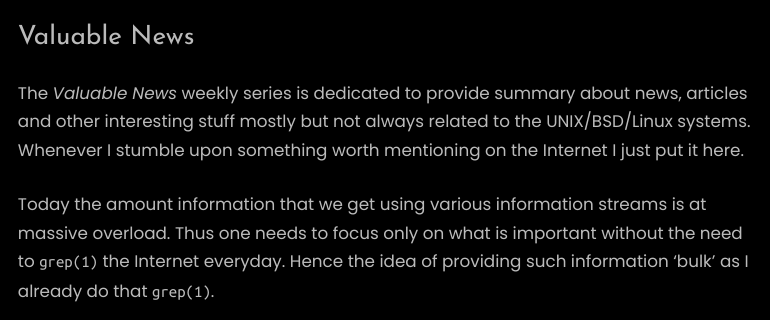
Latest 𝗩𝗮𝗹𝘂𝗮𝗯𝗹𝗲 𝗡𝗲𝘄𝘀 - 𝟮𝟬𝟮𝟲/𝟬𝟲/𝟭𝟱 (Valuable News - 2026/06/15) available.
https://vermaden.wordpress.com/2026/06/15/valuable-news-2026-06-15/
Past releases: https://vermaden.wordpress.com/news/
#verblog #vernews #news #bsd #freebsd #openbsd #netbsd #linux #unix #zfs #opnsense #ghostbsd #solaris #vermadenday
![[?]](https://files.mastodon.social/accounts/avatars/000/396/350/original/707d3beea6076986.png)
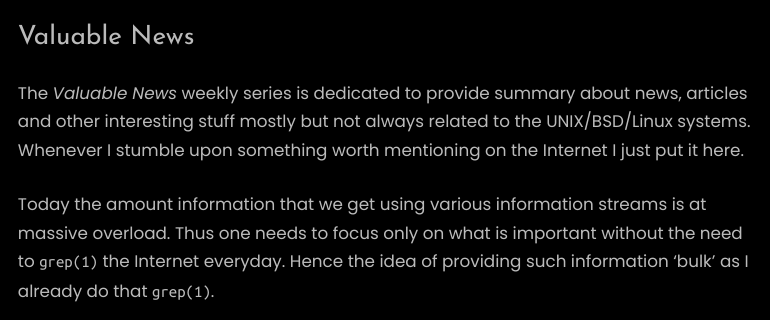
Latest 𝗩𝗮𝗹𝘂𝗮𝗯𝗹𝗲 𝗡𝗲𝘄𝘀 - 𝟮𝟬𝟮𝟲/𝟬𝟲/𝟭𝟱 (Valuable News - 2026/06/15) available.
https://vermaden.wordpress.com/2026/06/15/valuable-news-2026-06-15/
Past releases: https://vermaden.wordpress.com/news/
#verblog #vernews #news #bsd #freebsd #openbsd #netbsd #linux #unix #zfs #opnsense #ghostbsd #solaris #vermadenday
![[?]](https://media.bsd.network/accounts/avatars/000/001/413/original/d113a02fb84e4f5a.jpg)

If any of my work on #OpenBSD, or my highlight posts here (or elsewhere) has been helpful in the past, a small recurring monthly donation would be extremely appreciated. 
![[?]](https://media.bsd.cafe/bsdmmedia01/accounts/avatars/116/471/183/944/748/373/original/15cea23f36b87106.jpg)
Having followed a tutorial, I could make #WireGuard wg-quick work on my #OpenBSD, but not without DNS query leaks, so I learned I must figure out #unbound - however, a noob like me can only seem to manage to fix configuration errors while unbound itself apparently won't start because of this (which I found out after learning there's more than one way to debug unbound - not elegant, imho):
[1781449588] unbound[95585:0] error: bind: address already in use
[1781449588] unbound[95585:0] fatal error: could not open ports
I figured I should add my VPN interfaces to unbound.conf, but other than that I'm still clueless what else do I need to add or delete.
Thanks for your patience.
Getting closer by the day...
The European *BSD event of 2026! 😈⛳🐡
Get your 🎟️ at https://tickets.eurobsdcon.org/eurobsdcon/brussels/
While you're at it, don't forget to drop your abstract like it's hot! 🔥
https://events.eurobsdcon.org/
We are still and always looking for first-time *BSD speakers.
Whether you are just starting out or have a unique perspective to share, your voice matters!
The schedule will be published on 🗓️ 2026-07-15
For everything else, peek at https://2026.eurobsdcon.org/
More information is added all the time.
EuroBSDCon 2026 in Brussels, Belgium 🇧🇪
September 09-13, 2026
#RUNBSD #FreeBSD #NetBSD #OpenBSD #EuroBSDCon #EuroBSDCon2026 #BSD #CFP #Conference #Register
![[?]](https://media.bsd.cafe/bsdmmedia01/accounts/avatars/110/740/169/477/916/693/original/dfa8f1b9beefa405.png)
One year ago, today.
"Why and how we're migrating many of our servers most of our servers from Linux to the BSDs" - aka, "I solve problems"
![[?]](https://lemmy.ml/pictrs/image/9AY4jZuh4Q.png)
syslogd(8) privileged and non-privileged parts now separate binaries
In OpenBSD, the syslogd(8) system logger has already for a while now fork(2)ed the privileged from the non-privileged parts.
![[?]](https://media.tech.lgbt/accounts/avatars/113/923/105/002/660/874/original/01c8f78a74cf391f.png)


 [
[Always great when a CTO spews Marketing Talking Points...
https://www.youtube.com/watch?v=xCtFeukJs-E
Well folks TrueNAS ofically joins the circle of "Fuck you we make Enterprise money now" companies
The PFSense Netgate story all over again.
![[?]](https://files.mastodon.social/accounts/avatars/110/666/262/008/002/483/original/6d5ba8c8b0874505.png)
syslogd(8) privileged and non-privileged parts now separate binaries #openbsd
https://undeadly.org/cgi?action=article;sid=20260612080210
syslogd(8) privileged and non-privileged parts now separate binaries https://www.undeadly.org/cgi?action=article;sid=20260612080210 #openbsd #syslogd #privsep #privelegeseparation #separation #security #logging #development
![[?]](https://cdn.fosstodon.org/accounts/avatars/109/263/088/217/405/241/original/c5284ec55b385d49.jpeg)
Ahhh #OpenBSD. You just have to be different don't you, because, I dunno, pipes are insecure or something. https://github.com/DrHyde/shellscripts/commit/cb9697344e163dc846dfcb7e57188ed7ae21806d
After a flurry of recent commits by Claudio Jeker (claudio@), an important development milestone has been reached, mwx(4), the WIP #OpenBSD driver for Mediatek chips, can now associate and RX/TX w/ an open WiFi AP! 
"This commit was done over mwx(4) with a MT7921" 
![[?]](https://media.mastodontech.de/accounts/avatars/109/248/053/728/461/920/original/7ca48f767e1ff573.png)

![[?]](https://media.infosec.exchange/infosec.exchange/accounts/avatars/109/323/500/710/698/443/original/2a7e98c498cacee8.png)
![[?]](https://media.bsd.cafe/bsdmmedia01/accounts/avatars/110/896/104/742/825/185/original/3ea0586dd0f0f5b9.png)
Incidentally, I do like alternative forms of art. Amongst my favourite posts of all time:
<https://www.reddit.com/r/freebsd/comments/176qwzu/can_someoneron_tell_me_why_i_lie_fr4eebsd_so_much/>
Peace, and sugar lips, and so on …
"Seems like a smart person, I think someone got Hasselhoff wasted lol"
#artistry #pissartist #FreeBSD #OpenBSD #Squid #FreshPorts #peace #sugarlips #Reddit #Hasselhoff #wasted #Tequila
![[?]](https://snac.bsd.cafe/r1w1s1/s/avatar-aa8cf9fe6484f5e6eb3532137b7b8fee.png)
It's a fantastic look at early incident response, code auditing, and how OpenBSD handled one of the first major software supply-chain attacks.
Definitely worth a read:
http://miod.online.fr/software/openbsd/stories/trojan.html
OpenBSD stories—Trojaned OpenSSH
This is a story I had been considering writing for a long time, as many wrong or stupid things have been said or written at the time it happened. Being on a quite sensitive subject, I have however opted to redact a few things, especially the identity of two OpenBSD developers, as well as some IP addresses and other minor details which could help identify them. They will be referred to as dev1 and dev2 in this story. It does not matter who they are, and they really are trustworthy.
A Final Return for OpenBSD Anti-Return-Oriented Programming Mitigations
Return-Oriented Programming (ROP) continues to be a serious attack taking advantage of flaws in memory unsafe languages, particularly buffer overflows, to launch arbitrary code execution attacks by chaining together pieces of already existing code in loaded binaries and shared libraries, called gadgets. With the continued reliance on x86_64 CPUs in cloud and personal servers, mitigations that can meaningfully reduce the success of ROP attacks without significant overhead continue to be attractive. We propose the porting of one such software-based anti-ROP mitigation proposed by OpenBSD: compile-time instruction rewriting to avoid opportunities for ROP exploitation. We bring this mitigation, originally developed for the custom OpenBSD implementation of the LLVM compiler suite, to GCC by way of a standalone utility that sits in between the compiler and the assembler and rewrites potential gadget instructions before assembly into object code. Our utility provides a minimal reduction in gadgets with some penalties in binary sizes and performance impacts. We compare our GCC-ported standalone utility to the original OpenBSD LLVM mitigation and discovered that our standalone utility is weaker compared to the original LLVM-based mitigation. However, due to the overall weak reduction in gadgets for both the LLVM-based and GCC-based implementations, we conclude that seemingly obvious mitigations may prove to be anything but, and caution providing security improvements without significant testing and evaluation.