Search results for tag #emacs
![[?]](https://todon.nl/system/accounts/avatars/000/242/971/original/0a5e801576af597b.jpg)
org conflicts with windmove, where you press Shift-<arrow-key> to do stuff. as per https://orgmode.org/manual/Conflicts.html i have added hooks to config to remedy the conflict, but it often gets things wrong. e.g. when i bring up the date selector calendar in org, windmove is active, whereas i want to be able t Shift-<arrow-key> around the calendar, else i have to mouse it, but clicking a date closes the calendar, whereas i want select a date then modify the timestamp. has anyone around dealt with this conflict beyond the recommended hooks?
![[?]](https://cdn.fosstodon.org/accounts/avatars/113/120/298/592/447/698/original/f8f695d3b84a02e5.png)
TL;DR: mascot; one bug fix by Peter Mao; org-inside code review; one more patch review and two bug reports (analysis).
https://list.orgmode.org/87v79ay2ah.fsf@localhost/T/#u
Recording: https://archive.org/details/3-org-dev-meetup-on-sat-aug-16-19-00-utc-3
![[?]](https://gamerplus.org/system/accounts/avatars/114/497/966/782/841/054/original/c3c1b4d840d49021.png)
Wait, dead mic?
Alright, it is in fact Sunday-morning-in-Europe but I am elbow-deep in setting up some machine over the world's slowest network connection, so if you're into that this is that. #lispyGopherClimate #emacs #ssh #actuallySshX Just building #acl2 and #lambdaMOO . ( #lisp, #logic and #mud ) (and #i2p but there's no accounting for taste).
https://toobnix.org/w/gXLXQqxf5MYg1NDF2Ua6oA
Every week since 2022 ! #peertube #podcast #tech #live every 8am Sunday UTC.
![[?]](https://assets.chaos.social/accounts/avatars/000/297/530/original/18cb4aa74cb7f77f.jpg)
![[?]](https://files.sfba.social/accounts/avatars/109/366/565/784/469/346/original/baf10a597a06956f.jpeg)
now-playing.el is a remote control interface to the macOS music player from Emacs. The v1.1.0 update for it features a volume bar that is shown when the volume is changed.
now-playing.el is available on MELPA.
https://github.com/kickingvegas/now-playing/discussions/32

Alt...
Screenshot of now-playing.el, a remote control interface for the macOS Music app from Emacs.
![[?]](https://files.mastodon.social/accounts/avatars/114/474/673/669/732/705/original/7cdb235c8b8f6a5b.jpg)
![[?]](https://files.mastodon.social/accounts/avatars/106/655/696/667/891/366/original/0d2e16a5a1340dfc.png)
I just published a new post: A Tour of Magit's Status Interface. It walks through the main screen of Magit — my favourite Git client, which I use daily for work and personal projects — and how a single screen surfaces the full state of a repository.
It's written to be approachable even if you've never used Emacs.
![[?]](https://cdn.masto.host/fedicopyleftorg/accounts/avatars/114/797/464/859/441/527/original/e12cae8da5f59886.png)
I'm going to really try this daily #DogsOfMastodon thing. We #dog people must stand united & get more posts into the Fediverse of dogs than there are cats.
I mean, not that there is anything wrong with cats, it's just that #dogs are better than cats in the same way #Emacs is better than vim. 🤣
This is Lord Alfred Nelson of Puggington (more commonly known as Alfie).
Alfie died of cancer in late 2020, but his clueless tongue-hanging ways live on in the spirit of all dogs who'll eat anything.

Alt...
Alfie, a fawn pug with a fully black muzzle, stands in a blue harness with a collar staring at the camera with his tongue hanging out.
![[?]](https://activity.andros.dev/fileserver/01FQ7FH7RWJCEWS8FG7N1W26TX/attachment/original/01KN43H4RMKMC5R1CB0K868PYH.png)
«Elpher: my tweaks for better Gemini browsing in Emacs»
Elpher is the Gemini browser for Emacs, and it works wonderfully; its integration with GNU's editor is sublime.
https://en.andros.dev/blog/b18ae804/elpher-my-tweaks-for-better-gemini-browsing-in-emacs/
![[?]](https://media.mas.to/accounts/avatars/116/725/340/985/881/055/original/131ab7c7963a52da.png)
![[?]](https://s3.eu-central-2.wasabisys.com/mastodonworld/accounts/avatars/115/640/105/216/100/381/original/e2454d79a1e2ce95.png)
@SteveTux Removing obsolete code from #Emacs is a long process. Most of these themes have been effectively superseded by Prot's Modus or Ef themes, which have comprehensive coverage. However there are always users who still want the older themes to stay around, and Modus is not for everyone. I think such processes could benefit from ELPA. Packages could move from Emacs core to ELPA, without necessarily obsoleting them.
@jtr @ericsfraga I think modal editing in general is ergonomic and it doesn't particularly have to be vim. There's boon (https://github.com/jyp/boon) and meow (https://github.com/meow-edit/meow). Since you've never used vim, I'd recommend these packages instead.
I transitioned to emacs coming from vim so using evil (https://github.com/emacs-evil/evil) was natural to me. A huge drawback of this package is that it hijacks certain emacs bindings but that's also necessary if you want precise vim emulation.
Boon and meow offer modal editing and the benefits in terms of ergonomics without sacrificing emacs keybindings. I'm trying to move to boon but it's hard to let go of evil when I already know vim.
Good luck and I hope your pinky gets better. :)
![[?]](https://files.mastodon.social/accounts/avatars/000/028/444/original/69b4f78fde86fffd.jpg)
To people in the #lisp #emacs #programming space, I'm currently trying to get into learning Lisp as a hobby. My work mainly involves knowing python but like many people in physics, writing good code is never quite taught to us.
I would like to learn Lisp primarily out of interest but also it would benefit me if the structure of Lisp itself would teach me good programming practices that I could use when writing python.
Keeping this in mind, are there any Lisp dialect recommendations? I've heard good things about Common lisp and Clojure, but would be interested if those (or any other dialect) would serve my purpose.
![[?]](https://cdn.fosstodon.org/accounts/avatars/000/232/180/original/5e6de8c08fe975b9.png)


I did the fateful thing. I updated all my #emacs packages after not touching them for 5 months. Now I’m recompiling emacs from the latest sources to try to make mysterious new errors go away. You pull one thread…
![[?]](https://micro.blog/eludom/avatar.jpg)
I did the fateful thing. I updated all my #emacs packages after not touching them for 5 months. Now I’m recompiling emacs from the latest sources to try to make mysterious new errors go away. You pull one thread…
![[?]](https://cdn.masto.host/acp/accounts/avatars/000/060/722/original/d93a1631b2ff0201.png)
quick hack for nicer editing of 32-bit ARM assembly in #Emacs: https://codeberg.org/pulu/arm32-asm-mode.el
![[?]](https://cdn.masto.host/pdxsocial/accounts/avatars/113/874/091/203/433/099/original/8275427fac083ff8.png)
@ericsfraga @jtr and if you don't have an affinity for VI keybindings, check out Meow mode for #emacs
![[?]](https://cdn.fosstodon.org/accounts/avatars/109/123/616/822/093/848/original/0a7b4c0637a0a6d8.png)
Emacs pinky is becoming a thing for me recently.
I’ve been a happy user of CAPS as control, but recently my pinky started rebelling. My keyboard is non-standard. Time to think of other solutions :(
![[?]](https://media.mathstodon.xyz/accounts/avatars/000/004/340/original/afa3b5a1857bfff0.png)
Dear #emacs users. I like to use visual-line-mode and I also like to increase my font size a little. This results in help buffers, info buffers, ... looking weird due to the hard-coded line breaks at 70 characters (or whatever it is - I forget exactly).
In the screenshot, on the left there is a help buffer with unchanged font size and the hard wrapping fits fine. On the right, I've done M-x text-scale-increase and the hard wrapping breaks lines in weird places.
Question 1a: does anyone know how to get rid of the hard wrapping and just let emacs flow the text with word-wrap?
Question 1b: I was thinking of writing a minor mode which I'm thinking of calling no-hard-wrap to do it. My plan was to use a regex identifying a region that no-hard-wrap operates on. So for a helpful buffer, it would just operate on the region delimited between the heading Documentation and the heading References. In that region, if there is a line break followed by a non-space character, then I want to suppress the newline.
So, any tips for how to where to look for #elisp to alter a buffers display like that? Would an overlay do the trick? Make such newlines display as zero-width space or something?
EDIT: It should just be a regular space not a zero-width space.
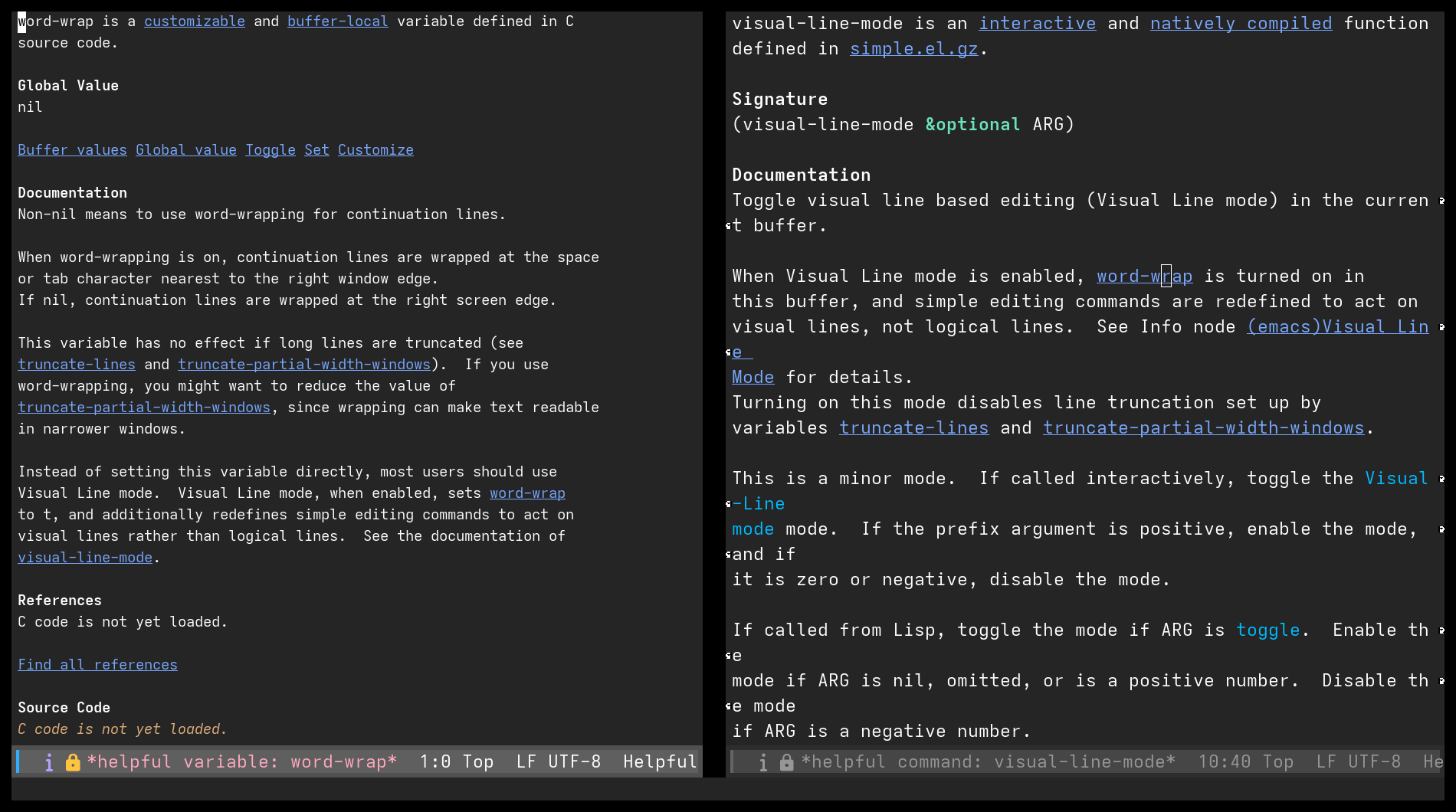
Alt...
Screen shot of side-by-side emacs buffers. One has default text scaling, while the other has increased scaling resulting in unsettling line wrapping.
![[?]](https://files.functional.cafe/accounts/avatars/108/197/412/836/833/295/original/36fd30acd388fccb.gif)
The pastoral tradition of emacs https://chrismaiorana.com/emacs-pastoral/
I sometimes find emacs to be whimsical really. It certainly allows me to express myself through my tools
I've implemented some great performance improvements in #Elfeed, the Atom/RSS feed reader for #Emacs.
- Save database when idle to avoid pauses.
- Use libxml for feed parsing by default instead of xml.el.
- Truncate the search list for faster display, with a button to show more.
- Header line caching for faster redisplay.
![[?]](https://ftp.ieji.de/accounts/avatars/114/329/869/160/467/389/original/92deb9a433cd6f2d.jpg)
Emacs Lisp has had bignums for quite a few years now (even though it got them much later than other lisps).
See also `integer-length' and company.
![[?]](https://neopaquita.es/system/accounts/avatars/114/216/985/597/139/445/original/6f66e21d54898efd.png)
Uhm, on 32 bit in Clozure CommonLisp (ccl):
(log (1+ most-positive-fixnum) 2)
29.0
2^29 -1 = most-positive-fixnum in CCL
#GNU #Emacs, 32 bit, compiled with --wide-int:
(log (1+ most-positive-fixnum) 2)
61.0
2^61 -1 = most-positive-fixnum in Elisp
Still, CL allows far more precision
than other languages:
CCL:
(expt most-positive-fixnum 16)
47634101215830029620862168293282105755619681803746312443773447750728239466188107611533078255091639820167255564829090159750828898191472066561
Elisp: totally wrong result.
Proof for CCL on correctness:
(log (expt (1+ most-positive-fixnum) 16) 2)
464.0
Tried converting my family to using GNU/Linux (specifically Linux Mint) to move away from whatever Windows has become, only to be informed to install Windows again because apparently Linux has a "weird" feeling to it for a desktop user. Isn't desktop Linux good enough now for the typical windows user?
I fully moved to Linux since 2018 with tiling WMs and vim keybindings that I don't find a desktop environments appealing. At this point, most of my computing is done in emacs anyway :P.